
Archive for July, 2009

Small Farmer Warns “HR2749 Will Put Me Out of Business”

Artisan Cheese from Pugs Leap Farm May Disappear if Food Safety Bill Passes
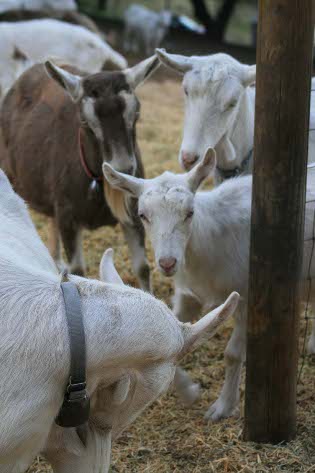
Pugs Leap Does

Pugs Leap Does

by Pascal Destandau of Pugs Leap Farm

Eric Smith and I own and operate a small diversified farm in Sonoma County, at Pugs Leap Farm we milk twenty seven goats by hand and make cheeses we sell at local farmers markets in Sonoma, Marin, Alameda and San Francisco. We have a few chickens and sell the eggs at the markets. In the next few years we hope to take to the markets the fruits and nuts from the orchards we planted. We also grow onions, garlics, chards, salad greens, tomatoes, corn, squash, strawberry and culinary herbs. We intend to add a few beehives next year.

HR2749 (The Food Safety Enhancement Act of 2009) which is currently making its way rapidly through the House of Representative will put us out of business.

HR2749 calls for:

a yearly registration with the FDA with a $500 fee

full HACCP plan for every type of produce sold or processed, for us that mean one plan for the dairy, one one for cheese making, one for transporting and retailing at the market, one for the fruits and vegetables, and another one for the nuts

FDA approved methods by which crops are raised and harvested. The most likely outcome will be along the lines of the leafy green ordinance, scorched earth and exclusion of any wildlife.

I have twenty two years experience in research and development and in technical operations, at a managerial level, in the pharmaceutical and personal care products industry. I therefore know very well the resources

Dry Creek Valley

Dry Creek Valley

needed to create and maintain a full HACCP plan. Creating one plan would take me about 100 hours and maintaining it would take 2 hours per day of production. Based on quotes I obtained in 2006 for laboratory testing, I estimate that I would need to budget $15,000/year just for the microbiological testing of the cheeses. The International Dairy Food Association (IDFA) has published some guidelines for HACCP which were used by the National Conference on Interstate Milk Shipments (NCIMS) when it developed a voluntary dairy HACCP program in parallel with the Pasteurized Milk Ordinance (PMO). To follow those guidelines I will have to start testing every batch of milk for drug residues, I will also have to tests for pesticide residues and mycotoxins. I am still in the process of researching what amount of testing will be needed for compliance and it is still unclear if I will be allowed to do my own testing or if I’ll need to send samples to a certified laboratory. This will be decided when the regulations are written.

Stopping feeding cattle a high grain diet would be much more efficient than an HACCP plan to eliminate E. Coli O157:H7 from our meat supply. The same for silage and Listeria. The practice of feeding antibiotics for faster weight gain has been linked to the presence of antibiotic resistant strains of salmonella in chicken, turkey, beef and pork. Recently MRSA has been found in pork meat.

The enforcement of HACCP plan for all food producers will do nothing to address those problems. Furthermore HACCP plans are very industry friendly and rely on self regulation and self regulation does not work. For example in 2006 from January to June, Cadbury knowingly shipped products tainted with salmonella; Cadbury’s defense is that the levels in the chocolate were too low to cause illness.

On July seven the White House appointed Michael R. Taylor Advisor to FDA Commissioner. The press release mention that it is his third appointment at the FDA and that Taylor will work to:

Assess current food program challenges and opportunities

Identify capacity needs and regulatory priorities

Develop plans for allocating fiscal year 2010 resources

Develop the FDA’s budget request for fiscal year 2011

Plan implementation of new food safety legislation.

The press release failed to mention Mr. Taylor connections with Monsanto.

Mr. Taylor began at the FDA in 1976 as a litigating attorney, he left to join King & Spalding where Monsanto was his personal client regarding food labeling and regulatory issues.. He returned to the FDA as Deputy Commissioner for Policy from 1991 to 1994, overseeing FDA’s policy development and rulemaking, including the implementation of the Nutrition Labeling and Education Act and issuance of new seafood safety rules. This was a new position created for him and he instantly became the FDA official with the greatest influence on GM food regulation, overseeing the development of government policy. He was part of the team that issued the very industry-friendly policy on food biotechnology and that approved the use of Monsanto’s genetically engineered growth hormone in dairy cows. He introduced the the concept of substantial equivalence as an appropriate method for determining safety. This is the basis for the lack of safety testing and the non labeling of GMO containing food. The same concept was used to prevent dairy products to be labeled as rBGH free.

Cutting the Goat Cheese

Cutting the Goat Cheese

Mr. Taylor left the FDA in 1994 for the USDA. In 1996 he went back to King & Spalding and in 1998 he was appointed vice president of Public Policy by Monsanto.

I am very concerned that Mr. Taylor will use his position to issue very tech heavy, industry friendly regulations that will place an unbearable burden on small producers and family farms.

Food safety is compromised by industrial farming practices not by sustainable farming. The cost of cheap food has been food safety. My personal check list for food safety is: no GMO, no trans fat, no high fructose corn syrup, no food colorants, no artificial flavors, no rBGH, no meat, eggs or dairy from CAFO’s. The short version is do not eat anything with a bar code.

Size based regulations are possible. In the new FDA egg safety regulations producers with less than 3,000 laying hen are exempt, producers with more than 3,000 but less than 50,000 have 36 months to comply, producers with more than 50,000 have 12 months to comply.

We do need farmers and consumers to start writing to your House Representative and request that HR 2749 include similar exemptions and provisions.

This post is part of Fight Back Friday’s on Food Renegade blog, see more ideas for food activism here.

This post is also part of Food Roots sustainability blog Carnival on Nourishing Days blog, trace your food roots here!

This post is also part of Real Food Wednesday blog carnival on KellytheKitchenkop.com, check out more foodie stuff here!

Tags: , , , ,

NAIS – It Ain’t Over Until The Fat Lady Sings

Written by: Chuck JolleyCattle Network

She belts one out on Monday.  Except ‘she’ will be a couple of he’s – Brooks and Dunn singing ‘That ain’t no way to go.’

The heavily promoted comment period for the U.S.D.A.’s National Animal Identification System (N.A.I.S.) listening tour will end on Monday. According to the U.S.D.A., comments received on or before this date will be considered.  Hopefully written comments received after the final Omaha meeting will be taken more seriously than spoken comments were during the ‘live,’ face-to-face meetings.

“While the roundtables and public listening sessions are complete, I encourage those of you who still would like to share your concerns and suggestions about N.A.I.S. to submit your written comments by August 3,” said Ag Secretary Tom Vilsack, “We look forward to considering all the feedback before deciding on the future direction of U.S.D.A.’s traceability efforts.”

U.S.D.A. has posted a feedback page on the N.A.I.S. Web site.  Whether you’re your for it or against it, go to www.usda.gov/nais/feedback now to provide your suggestions and comments.

If Vilsack is counting noses, N.A.I.S. will be deep-sixed on August 4.  He announced the listening tour on May 15 as a way to find common ground for the development of the always controversial program.  To be painfully blunt, common ground never existed.  Only a pitifully small handful of people stood up for a national program during the 14 city tour.  The vast majority of the often overly enthusiastic crowd spoke against N.A.I.S. using very specific and occasionally salty language.  Trying to talk those people into accepting an animal identification program will be tougher than talking a card-carrying N.R.A. member out of his gun.

In fact, more than a few N.R.A. card-carrying farmers have promised to show anyone representing NAIS who dares step foot on his or her property a personal collection of fire arms.  Barrel end first.

As a voluntary program, N.A.I.S. might have worked but only with the strongest possible assurances from the U.S.D.A. that ‘voluntary’ isn’t code for ‘mandatory’ within a few short years.  Even that approach would be a hard sell as most of the speakers were outspoken about their innate distrust of anything that smacked of “Hello, I’m from the government and I’m here to help you.”

These are people who are used to doing it themselves.  If any help is needed, it’s neighbor-to-neighbor, not federales to farmers.  The mistake the USDA made was trying to organize this program from the top down.  Going after the cooperation of state ag agencies and trade associations, they assumed, would win the day and the big boys did fall in line, lured by the promise of an ever expanding foreign trade opportunity.  NAIS, though, is a bottom up program.  It can only succeed with the consent and cooperation of the hundreds of thousands of small farmers from Portland, ME to Portland OR.

They said no.

If there is any confusion about the meaning of that word, maybe the U.S.D.A. can understand it a little better by clicking here.

Tags: , , , , ,

NAIS — It Ain’t Over Until The Fat Lady Sings

Written by: Chuck JolleyCattle Network

She belts one out on Monday. Except ‘she’ will be a couple of he’s — Brooks and Dunn singing ‘That ain’t no way to go.’

The heavily promoted comment period for the U.S.D.A.’s National Animal Identification System (N.A.I.S.) listening tour will end on Monday. According to the U.S.D.A., comments received on or before this date will be considered. Hopefully written comments received after the final Omaha meeting will be taken more seriously than spoken comments were during the ‘live,’ face-to-face meetings.

“While the roundtables and public listening sessions are complete, I encourage those of you who still would like to share your concerns and suggestions about N.A.I.S. to submit your written comments by August 3,” said Ag Secretary Tom Vilsack, “We look forward to considering all the feedback before deciding on the future direction of U.S.D.A.’s traceability efforts.”

U.S.D.A. has posted a feedback page on the N.A.I.S. Web site. Whether you’re your for it or against it, go to www.usda.gov/nais/feedback now to provide your suggestions and comments.

If Vilsack is counting noses, N.A.I.S. will be deep-sixed on August 4. He announced the listening tour on May 15 as a way to find common ground for the development of the always controversial program. To be painfully blunt, common ground never existed. Only a pitifully small handful of people stood up for a national program during the 14 city tour. The vast majority of the often overly enthusiastic crowd spoke against N.A.I.S. using very specific and occasionally salty language. Trying to talk those people into accepting an animal identification program will be tougher than talking a card-carrying N.R.A. member out of his gun.

In fact, more than a few N.R.A. card-carrying farmers have promised to show anyone representing NAIS who dares step foot on his or her property a personal collection of fire arms. Barrel end first.

As a voluntary program, N.A.I.S. might have worked but only with the strongest possible assurances from the U.S.D.A. that ‘voluntary’ isn’t code for ‘mandatory’ within a few short years. Even that approach would be a hard sell as most of the speakers were outspoken about their innate distrust of anything that smacked of “Hello, I’m from the government and I’m here to help you.”

These are people who are used to doing it themselves. If any help is needed, it’s neighbor-to-neighbor, not federales to farmers. The mistake the USDA made was trying to organize this program from the top down. Going after the cooperation of state ag agencies and trade associations, they assumed, would win the day and the big boys did fall in line, lured by the promise of an ever expanding foreign trade opportunity. NAIS, though, is a bottom up program. It can only succeed with the consent and cooperation of the hundreds of thousands of small farmers from Portland, ME to Portland OR.

They said no.

If there is any confusion about the meaning of that word, maybe the U.S.D.A. can understand it a little better by clicking here.

Chuck Jolley is a free lance writer, based in Kansas City, who covers a wide range of ag industry topics for Cattlenetwork.com and Agnetwork.com.

Tags: , , , , , ,

The Amazing Failure of NAIS

Written by Harlan Hentges

Thursday, 23 July 2009 14:38

About the Author

Mr. Hentges is a 1992 graduate of the University of Texas with a juris doctorate from the School of Law and a Master of Public Affairs from the Lyndon B. Johnson School of Public Affairs. He is a 1987 graduate of Oklahoma State University with a bachelor of science in agricultural economics.

He is admitted to practice law in the States of Oklahoma and Texas and the Federal District Court for the Western District of Oklahoma. He is a member of the Oklahoma Bar Association, the Oklahoma County Bar Association and the American Agricultural Law Association.

Mr. Hentges’s legal practice is concentrated in agricultural law, civil litigation, Endangered Species Act, eminent domain and appellate law.

Phone: (405) 340 6554

Harlan Hentges P. L. L. C.

1015G Waterwood Parkway Ste F1

Edmond, OK 73034

The National Animal Identification System (NAIS) would have gathered and introduced a huge amount of new data into the food supply chain. Data is very valuable in any supply chain and would certainly be valuable to food. USDA had the power and resources of the US government and support of multinational corporations that dominate the U. S. meat market. Under these circumstances, getting data into the food supply chain should have been like shooting fish in a barrel. Instead it was an amazing failure. Why?

I submit that USDA and their industry partners have a common flaw in structure, leadership and management. The flaw causes them to be blind to social, cultural and economic values of food and farming . After several years and hundreds of millions of dollars, USDA continues to face fierce public opposition to NAIS and members of congress have declared NAIS a failure and have moved to eliminate funding. The failure of NAIS reveals a flaw and its potentially negative consequences for the food supply chain.

For at least four decades the U. S. consumer and producer have expressed a preference for a food and farming system that is consistent with their social and cultural values. In the 1970’s the American Agricultural Movement radically protested the loss of farms. In the 1980’s Farm Aid lamented the loss of farms. The 1990’s saw the growth of organic foods and specialized stores like Whole Foods and Wild Oats. The 2000’shave movements such as local food, real food, raw food, slow food, vegetarian, and vegan. All of these movements and many more are vocal, national, well-publicized and they express the desire for food that is consistent with social and cultural values. Even the Pope writes about the lack of social and cultural values in our food system.

The only way to add social and cultural value to food is to provide consumers with information about their food . Valuable information would include where it was produced, by whom and under what conditions. This would permit consumers to know if the food they purchase is consistent with their values and enable them to act on those values.

When USDA and its multinational corporate partners under took the implementation of NAIS, they ignored virtually all of the value information might have to the food supply chain. They focused on only one objective — to track and, if needed, control the movement of every animal in the U. S. They claimed that in the event a disease was discovered in the U. S. every exposed animal could be identified, located, and quarantined or destroyed. This ability would benefit only one segment of the food supply chain, the large meat packers. By controlling the movement of animals, the slaughter facilities could continued to operate with as little disruption as possible . Theoretically, saving the packers as much downtime would justify the cost of the system.

Despite a ubiquitous desire for food that is consistent with social and cultural values, USDA and the multinationals designed NAIS so that any information about the animal was lost at the slaughter facility . Information about the source of the animal would never be available to a consumer . Information about the customer’s satisfaction could not be available to the farmer.

It is apparent that USDA and the multinationals failed to consider that information would be valuable to the producer or the consumer. This failure is inexcusable. The values of food and farming are thoroughly addressed in books like Fast Food Nation and Omnivore’s Dilemma and films like Food, Inc. and Fresh. It is undeniable that there is a widespread concern, and in some cases outrage, that industrialized agriculture is responsible for the decline of rural economies and communities, economic oppression of farmers, environmental degradation and mistreatment of animals. Yet USDA and the multinationals act as if information about where, by whom and how food is raised is irrelevant to the food supply chain and the value of food.

USDA and the multinationals failure to recognize the value of information about food is really a failure to recognize the value of food. USDA and the multinationals failed, I submit, because they do not know why food is valuable. Food is not valuable because of its nutritional content. Food is valuable because it comes from one of many economically viable farmers who live nearby and can produce a supply of food that is safe and secure for the long term. It is valuable because it is provided through supply chain that functions freely and is not subject to foreign, corporate or governmental control. Food is valuable because it comes from animals and crops that are genetically diverse so that they are not all susceptible to the same disease. Food is valuable because it is produced with farming methods that preserve the productivity of the land and produces offspring and seeds for the following year. Food is valuable because it is consistent with moral, social and economic values that sustain communities indefinitely. The amazing failure of NAIS indicates that the USDA and the multinationals do not understand or do not share these values.

Due to USDA’s power and the multinationals to influence the nation’s and world’s food supply, this lack of understanding of the value of food is a huge obstacle. Nonetheless, the challenge and opportunity in agriculture and food markets is to provide this value despite USDA’s policies and the market power of multinationals. Each food recall, each disease outbreak, each bankrupt farmer, and each contaminated water body is a new and better opportunity and a greater challenge to provide food of greater value.

Tags: , , , , , , , , , , , , ,

Wisconsin’s war against agriculture: Fines, imprisonment and property seizure

July 23, 2009

By Marti Oakley (Food Freedom)

Paul Griepentrog inside the greenhouseThe first thing they did when they got the authority to write rules … was to grant themselves the authority to conduct warrantless searches. Wisconsin is in the process of coercing farmers and backyard producers … into NAIS, and the accompanying Premises ID program, by threatening to withhold any of the licenses they control.” Paul Griepentrog

In the course of researching various topics, running down leads on information and ferreting out the plans behind the public propaganda used to infringe on one right after another, I sometimes stumble across someone who has so much verifiable information, I am left astounded.  This was the case when I happened across a gentleman farmer named Paul Griepentrog while researching the laws and bills about Premises ID and the National Animal Identification System (NAIS).

I already knew the mandatory law had been bought and paid for in Wisconsin through the use of a USDA “cooperative agreement” to the tune of $35 million.

In a recent interview I asked Paul to answer a few questions about what is really happening to Wisconsin residents who are being forced onto these illegal programs:

Q:  Does the Animal Health Protection Act of 2003 actually authorize the Animal Identification System or Premises ID?

A: There is nothing in that bill giving them authority to create or establish the National Animal Identification System (NAIS).  That law has been misquoted saying that it is the authority for NAIS.  We have repeatedly sent letters to USDA and Tom Vilsack asking him to show the section of that law that gives the authority but he refuses to answer or acknowledge the letters.

Q: Has the USDA, in collusion with the Wisconsin AG department, threatened any farms that you know of?

A: Dwayne Brander on behalf of Dr. McGraw, Assistant State Veterinarian, goes out to farms telling them that if they don’t renew or register their premises in the State of Wisconsin they will file suit against them for failing to comply, using the county DA and calling it a civil forfeiture.

Wisconsin is in the process of coercing farmers and backyard producers in an effort to force them onto NAIS and the accompanying Premises ID program by threatening to withhold any of the licenses they control and would refuse to give the license unless you signed up.

Q: Is there a part of the law in Wisconsin that allows for fines and imprisonment based on the sole allegations of these agencies or representative personnel from USDA or DATCP in Wisconsin?

A: Here is section 95 from the Wisconsin bill implementing the “voluntary” NAIS/Premises ID law:

CHAPTER 95

ANIMAL HEALTH

95.23 Disease investigation and enforcement.

95.23(1)

(1) Authorized inspectors and agents of the department may enter at reasonable times any premises, building or place to investigate the existence of animal diseases or to investigate violations of or otherwise enforce the laws relating to animal health. Any animals or materials suspected of being infected may be examined or tested. No person shall obstruct or interfere with such investigation or enforcement work, or attempt to do so, in any manner, by threat or otherwise.

95.23(2)

(2) Upon request of an authorized inspector or agent of the department, sheriffs and police officers shall assist in the enforcement of the laws relating to animal health.

95.99 Penalties.

95.99(1)

(1) Any person who violates this chapter, or an order issued or a rule adopted under this chapter, for which a specific penalty is not prescribed shall, for the first offense, be fined not more than $1,000; and for any subsequent offense fined not less than $500 nor more than $1,000, or imprisoned not more than 6 months or both.

95.99(2)

(2) The department may seek an injunction restraining any person from violating this chapter or any rule promulgated under this chapter.

95.99(3)

(3) A person who violates this chapter or any rule promulgated or order issued under this chapter, for which a specific penalty is not prescribed, may be required to forfeit not less than $200 nor more than $5,000 for the first offense and may be required to forfeit not less than $400 nor more than $5,000 for the 2nd or subsequent offense committed within 5 years of an offense for which a penalty has been assessed under this section. A forfeiture under this subsection is in lieu of a criminal penalty under sub.

~~~~~~~~~~~~~~~~~~~~~~~~~~

Q: Do citizens have the right to demand a full disclosure of the exact laws and basis under which USDA and Wisconsin have charged them?  Is there any defense against these attacks?

A: There seems to be none.  In the cooperative agreement it states all applicable federal laws shall apply.  There are certain major State and Federal Constitutional issues that these laws are in conflict with.

Q: Who exactly is asking for this information?

A: The Department of Agriculture, State of Wisconsin administered by Assistant State Veterinarian, Dr. Paul McGraw; both knowing this has nothing to do with livestock or food safety.  This comes from The World Trade Organization and their trade program OIE. http://www.oie.int/eng/en_index.htm World Organization Animal Health.

Q: Where is the information stored? For what purpose?

A: Initially intake is at state level, and then it moves through forms records management plan.  There are different steps on how they process this information.  From everything I read, a disease outbreak would give state, federal and international interest’s access.

Q: Who is storing the information?

A: Wisconsin Department of Agriculture and then to Wisconsin Livestock Identification Consortium with (WLIC) as final repository in Canada. The WLIC is comprised of various agriculture groups, breed associations and companies selling RFID tags.

Rep. Obey & Sen. Kohl helped to get WLIC started and moved the data base to Canada.  The head of WLIC initially was Gary Tauchen who is now a Wisconsin representative and sitting on the house AG committee.

In my own case, I have been registered twice after the fire number on my property changed.  Once under the original number and my name and again under the newly assigned number and my farm name; I did not register for Premises ID on either occasion and was signed up without my knowledge or consent.

Q: If the WLIC is listed as the last repository of data mined information, how did files on Wisconsin agricultural properties end up being stored in Canada?

A: WLIC with the help of Rep. Obey and Sen. Kohl although I don’t know for sure how this was accomplished. The intention was to avoid any Freedom of Information Act (FOIA) request or open information requests until they passed the 2008 Farm Bill and included a provision in that bill saying that these files would not be available to FOIA requests.

Q.  Who had access to these files when they were outside the country?

A:  We don’t know.  Once it was outside US jurisdiction we had no way of knowing.

Q:  Are you able to get copies of your personal file from the Canadian data bank?

A:  I was able to obtain the premises information pursuant to the forms records management plan.  To my knowledge I am only the second person to do so.

Q:  We know these programs have nothing to do with tracking animal disease and are actually meant to end competition for industrialized agricultural interests, and to seize control of agricultural lands and livestock….who are the actual players that will benefit from these programs?

A: The big corporate industrialized agriculture operators….Cargill, Tyson, Monsanto and others, because they would see the end to competition and obtain virtually full control over all agriculture.

Q:  Are Wisconsin politicians either state or federal willing to speak to you about NAIS, Premises ID or the fake food safety bills?

A: On the Federal level, Sen. Kohl and Rep. Obey will not take my calls.

(*Writer’s note: I made my own calls to these offices and when I stated what I was calling in reference to, the staffers got really nasty and then hung up)

In fact Sen. Kohl’s staffer, Kim Cates’ husband is on the Agriculture Consumer Protection Citizen board.  He would not even meet with John Kinsman of Family Farm Defenders to discuss the issue.

On the state level are the continuous lies.  These people will say Premises ID has nothing to do with NAIS.  They say this even though they have been shown the cooperative agreement between USDA and Wisconsin DATCP outlining Premises ID as the first step.  They refuse to look at or acknowledge the legal documents.

DATCP had a document on the Wisconsin Legislative information Bureau site saying that the Amish don’t have any problem with this.  If the Amish don’t have a problem with it why are they suing Emmanuel Miller Jr., an Amish from Clark County?

Steve Kagen would not address our concerns and he’s on the US house Ag sub- committee that held a hearing on NAIS and is also involved in the food safety bills and won’t address our concerns even there.  He is working right now to get funding to move Wisconsin into phase II of NAIS which is the mandatory chipping and tagging of all animals.

I will say that Sen. Feingold has been willing to listen to our concerns both in his Washington office and in the state office.

montages photobucketAlthough there is a bill in Wisconsin which would restore voluntary participation I feel it is nothing more than an attempt at political redemption by the same people who passed the mandatory bill to begin with, in that they are fully aware that this bills will be sent to the House Ag committee and never see the light of day.  This is merely political posturing…. The house, senate and government are all controlled by Democrats.  This may be nothing more than a smoke screen while they make mandatory phase II which is the tagging and chipping, which can’t be done unless you have a Premises ID.
~~~~~~~~~~~~~~~~~~~~~~~~~~

Paul Griepentrog shows that, in the end, what was billed and sold to Wisconsin farmers and herders as a strictly “voluntary” system turns out to be a mandatory system operated much like a police state enforcement policy.  There can be no doubt, especially in light of the hyped up investigation and enforcement policies that this law in Wisconsin is less about disease and more about property seizure and forfeiture.

Wisconsin is the blueprint for the remaining states:  what happens there is going to happen to all independent ranchers, farmers and producers across the country if any of these fake food safety bills, or National Animal Identification System (NAIS) is passed into law.

© 2009 Marti Oakley

Tags: , , , , ,

Organic farmers plead for help from USDA Secretary Vilsap

Written by: Bill Suydam, Editor, Health Spectator

This posting from the Cornucopia Institute is a video that portrays an emergency meeting of organic dairy farmers in Wisconsin pleading with U.S. Department of Agriculture Secretary Tom Vilsack to level the playing field against factory farms so that small farmers can survive.

One of the ironies of this piece occurs at the beginning, when an emcee approaches the refreshment stand at the fair and notes that bottled water is selling for $2.00—and milk for $0.50.

“Can farmers really be expected to sell milk for one quarter the price of water?” he asks the camera.

The farmers are protesting the fact that many large “organic” dairy farms flaunt the regulations, while “conventional” dairy farms—ironically the current term used for farms that inject their dairy cows with hormones to force them to produce twice as much milk as normal—may milk as many as 7200 cows a day.

Meanwhile, small farmers are finding it tough to survive, and more go out of business every day. This is not what we want to see if we are going to keep ourselves and our children healthy with wholesome products from small, local organic farms.

Tags: , , , , , ,

Wisconsin’s war against agriculture: Fines, imprisonment and property seizure

By Marti Oakley (Food Freedom)

Paul  Griepentrog  inside  the  greenhouseThe first thing they did when they got the authority to write rules… was to grant themselves the authority to conduct warrantless searches. Wisconsin is in the process of coercing farmers and backyard producers … into NAIS, and the accompanying Premises ID program, by threatening to withhold any of the licenses they control.” Paul Griepentrog

In the course of researching various topics, running down leads on information and ferreting out the plans behind the public propaganda used to infringe on one right after another, I sometimes stumble across someone who has so much verifiable information, I am left astounded. This was the case when I happened across a gentleman farmer named Paul Griepentrog while researching the laws and bills about Premises ID and the National Animal Identification System (NAIS).

I already knew the mandatory law had been bought and paid for in Wisconsin through the use of a USDA “cooperative agreement” to the tune of $35 million.

In a recent interview I asked Paul to answer a few questions about what is really happening to Wisconsin residents who are being forced onto these illegal programs:

Q: Does the Animal Health Protection Act of 2003 actually authorize the Animal Identification System or Premises ID?

A:There is nothing in that bill giving them authority to create or establish the National Animal Identification System (NAIS). That law has been misquoted saying that it is the authority for NAIS. We have repeatedly sent letters to USDA and Tom Vilsack asking him to show the section of that law that gives the authority but he refuses to answer or acknowledge the letters.

Q: Has the USDA, in collusion with the Wisconsin AG department, threatened any farms that you know of?

A: Dwayne Brander on behalf of Dr. McGraw, Assistant State Veterinarian, goes out to farms telling them that if they don’t renew or register their premises in the State of Wisconsin they will file suit against them for failing to comply, using the county DA and calling it a civil forfeiture.

Wisconsin is in the process of coercing farmers and backyard producers in an effort to force them onto NAIS and the accompanying Premises ID program by threatening to withhold any of the licenses they control and would refuse to give the license unless you signed up.

Q: Is there a part of the law in Wisconsin that allows for fines and imprisonment based on the sole allegations of these agencies or representative personnel from USDA or DATCP in Wisconsin?

A: Here is section 95 from the Wisconsin bill implementing the “voluntary” NAIS/Premises ID law:

CHAPTER 95

ANIMAL HEALTH

95.23 Disease investigation and enforcement.

95.23(1)

(1) Authorized inspectors and agents of the department may enter at reasonable times any premises, building or place to investigate the existence of animal diseases or to investigate violations of or otherwise enforce the laws relating to animal health. Any animals or materials suspected of being infected may be examined or tested. No person shall obstruct or interfere with such investigation or enforcement work, or attempt to do so, in any manner, by threat or otherwise.

95.23(2)

(2) Upon request of an authorized inspector or agent of the department,sheriffs and police officers shall assist in the enforcement of the laws relating to animal health.

95.99 Penalties.

95.99(1)

(1) Any person who violates this chapter, or an order issued or a rule adopted under this chapter, for which a specific penalty is not prescribed shall, for the first offense, be fined not more than $1,000; and for any subsequent offense fined not less than $500 nor more than $1,000, or imprisoned not more than 6 months or both.

95.99(2)

(2) The department may seek an injunction restraining any person from violating this chapter or any rule promulgated under this chapter.

95.99(3)

(3) A person who violates this chapter or any rule promulgated or order issued under this chapter, for which a specific penalty is not prescribed,may be required to forfeit not less than $200 nor more than $5,000 for the first offense and may be required to forfeit not less than $400 nor more than $5,000 for the 2nd or subsequent offense committed within 5 years of an offense for which a penalty has been assessed under this section. A forfeiture under this subsection is in lieu of a criminal penalty undersub.

~~~~~~~~~~~~~~~~~~~~~~~~~~

Q: Do citizens have the right to demand a full disclosure of the exact laws and basis under which USDA and Wisconsin have charged them? Is there any defense against these attacks?

A:There seems to be none. In the cooperative agreement it states all applicable federal laws shall apply. There are certain major State and Federal Constitutional issues that these laws are in conflict with.

Q: Who exactly is asking for this information?

A:The Department of Agriculture, State of Wisconsin administered by Assistant State Veterinarian, Dr. Paul McGraw; both knowing this has nothing to do with livestock or food safety. This comes from The World Trade Organization and their trade program OIE.http://www.oie.int/eng/en_index.htm World Organization Animal Health.

Q: Where is the information stored? For what purpose?

A: Initially intake is at state level, and then it moves through forms records management plan. There are different steps on how they process this information. From everything I read, a disease outbreak would give state, federal and international interest’s access.

Q: Who is storing the information?

A:Wisconsin Department of Agriculture and then to Wisconsin Livestock Identification Consortium with (WLIC) as final repository in Canada. The WLIC is comprised of various agriculture groups, breed associations and companies selling RFID tags.

Rep. Obey & Sen. Kohl helped to get WLIC started and moved the data base to Canada. The head of WLIC initially was Gary Tauchen who is now a Wisconsin representative and sitting on the house AG committee.

In my own case, I have been registered twice after the fire number on my property changed. Once under the original number and my name and again under the newly assigned number and my farm name; I did not register for Premises ID on either occasion and was signed up without my knowledge or consent.

Q: If the WLIC is listed as the last repository of data mined information, how did files on Wisconsin agricultural properties end up being stored in Canada?

A:WLIC with the help of Rep. Obey and Sen. Kohl although I don’t know for sure how this was accomplished. The intention was to avoid any Freedom of Information Act (FOIA) request or open information requests until they passed the 2008 Farm Bill and included a provision in that bill saying that these files would not be available to FOIA requests.

Q. Who had access to these files when they were outside the country?

A: We don’t know. Once it was outside US jurisdiction we had no way of knowing.

Q: Are you able to get copies of your personal file from the Canadian data bank?

A: I was able to obtain the premises information pursuant to the forms records management plan. To my knowledge I am only the second person to do so.

Q: We know these programs have nothing to do with tracking animal disease and are actually meant to end competition for industrialized agricultural interests, and to seize control of agricultural lands and livestock….who are the actual players that will benefit from these programs?

A:The big corporate industrialized agriculture operators….Cargill, Tyson, Monsanto and others, because they would see the end to competition and obtain virtually full control over all agriculture.

Q: Are Wisconsin politicians either state or federal willing to speak to you about NAIS, Premises ID or the fake food safety bills?

A:On the Federal level, Sen. Kohl and Rep. Obey will not take my calls.

(*Writer’s note: I made my own calls to these offices and when I stated what I was calling in reference to, the staffers got really nasty and then hung up)

In fact Sen. Kohl’s staffer, Kim Cates’ husband is on the Agriculture Consumer Protection Citizen board. He would not even meet with John Kinsman of Family Farm Defenders to discuss the issue.

On the state level are the continuous lies. These people will say Premises ID has nothing to do with NAIS. They say this even though they have been shown the cooperative agreement between USDA and Wisconsin DATCP outlining Premises ID as the first step. They refuse to look at or acknowledge the legal documents.

DATCP had a document on the Wisconsin Legislative information Bureau site saying that the Amish don’t have any problem with this. If the Amish don’t have a problem with it why are they suing Emmanuel Miller Jr., an Amish from Clark County?

Steve Kagen would not address our concerns and he’s on the US house Ag sub- committee that held a hearing on NAIS and is also involved in the food safety bills and won’t address our concerns even there. He is working right now to get funding to move Wisconsin into phase II of NAIS which is the mandatory chipping and tagging of all animals.

I will say that Sen. Feingold has been willing to listen to our concerns both in his Washington office and in the state office.

montages  photobucketAlthough there is a bill in Wisconsin which would restore voluntary participation I feel it is nothing more than an attempt at political redemption by the same people who passed the mandatory bill to begin with, in that they are fully aware that this bills will be sent to the House Ag committee and never see the light of day. This is merely political posturing…. The house, senate and government are all controlled by Democrats. This may be nothing more than a smoke screen while they make mandatory phase II which is the tagging and chipping, which can’t be done unless you have a Premises ID.

~~~~~~~~~~~~~~~~~~~~~~~~~~

Paul Griepentrog shows that, in the end, what was billed and sold to Wisconsin farmers and herders as a strictly “voluntary” system turns out to be a mandatory system operated much like a police state enforcement policy. There can be no doubt, especially in light of the hyped up investigation and enforcement policies that this law in Wisconsin is less about disease and more about property seizure and forfeiture.

Wisconsin is the blueprint for the remaining states: what happens there is going to happen to all independent ranchers, farmers and producers across the country if any of these fake food safety bills, or National Animal Identification System (NAIS) is passed into law.

© 2009MartiOakley

Tags: , , , , , , , , , ,

NAIS/Premises ID….FCLDF takes it to the courts

NAIS/Premises ID….FCLDF takes it to the courts

Written by: Marti Oakley – Proud Political Junkie’s Gazette

farmer3_deesA decision by U.S. District Judge Rosemary Collyer, located in the Washington District of Criminals, throwing out a lawsuit brought by Farm to Consumer Legal Defense Fund (FCLDF) asking the court to halt the implementation of NAIS, was based on her assertion that there is no federal law and/or, no federal regulation ordering the implementation of the National Animal Identification System (NAIS).  FCLDF brought the suit asking for temporary injunctive relief……a move that was good in its intentions but obviously filed too early.  As no law or regulation exists to authorize NAIS/Premises ID and the claims by USDA and Tom Vilsack go unsubstantiated despite repeated requests to produce the authority they claim, injunctive relief could not be granted as no law has been passed …yet,….although multiple legislative assaults are in the works.

I guess this statement in her opinion would answer the question posed to Tom Vilsack and other officials from the USDA, demanding to know under what authority or law NAIS is being implemented and is scheduled to become mandatory.  Turns out, according to Judge Collyer…there is none.  It would also answer the question as to why Mr. Vilsack nor the USDA will respond to the question or even acknowledge it has ever been asked.

It is apparent from this ruling there is no legal, lawful, legislative regulation or statute which allows, establishes or mandates NAIS.   The USDA, using its so-called “rule-making” authority, which is nothing less than illegal law enacted by a non-elected bureaucracy, has simply been the tool to by-pass constitutional rights and liberties in an effort to expand the power and control of not only the agency itself, but also the federal government which has long since exceeded its Constitutional authority and power on many levels.

Since the court has ruled in this way, does this not make the bribes paid to state officials to “voluntarily” implement NAIS , euphemistically called [cooperative agreements]..an act of collusion?  Wouldn’t this also make refusal to comply with state enacted mandates, for which the Judge herself has admitted, there is no lawful basis, a legal protection for farmers and ranchers?  And would this not also include the prohibition on the SWAT team-like assaults being perpetrated in states like Wisconsin which accepted one of the USDA’s multi-million dollar bribes to do a test run on NAIS/Premises ID?

The judge also seemed not to be concerned about the impending loss of private property rights which is an intended result of NAIS/Premises ID; apparently having no judicial problem with livestock owners being referred to as [stakeholders, legally implying they have an interest in but are not the owners of their own property] and land owners relegated to the category of [tenants or managers] again removing them from the rightful legal ownership of the land.

Judge Collyer’s expert legal opinion went on to say that NAIS is “an identification and tracking program developed by the U.S. Department of Agriculture and adopted by state agriculture departments voluntarily”.  This is a patently false statement by the court.  USDA DID NOT develop the NAIS or Premises ID program.  USDA is simply trying to codify into law Codex Alimentarius and all of its international regulations and standards of which NAIS/Premises Id is a key feature.

Again, paying bribes to state officials to implement what the Judge herself identifies as a non-existence law or regulation should have warranted the halting of any programs regardless of what non-elected agency had launched them into the public domain on behalf of Bio-tech and Codex Alimentarius.

“Collyer continued with….”They, however, completely fail to address Michigan state law, which authorizes the director of MDA to adopt programs such as NAIS compliance for cattle, and plaintiffs’ reliance on federal law is misplaced.”  The Judge does not admit or allude to the fact that Michigan would not have enacted this law without federal interference or encouragement.

The Judge seemed not to consider that Michigan officials had illegally entered into an agreement with USDA, which was the catalyst for the Michigan law, and had accepted monetary assistance, cooperative funding or what is in my opinion, legalized bribery to do so.

The Judge seemed not to be aware of a precedence, (a judicial concept continually invoked by courts when their intended rulings are in conflict with actual law) or, as in this instance totally ignored by the court as it would have rendered the ruling void,  which states:

“The general misconception is that any statute passed by legislators bearing the appearance of law constitutes the law of the land. The Constitution of the United States is the supreme law of the land, and any statue, to be valid, must be in agreement. It is impossible for both the Constitution and a law violating it to be valid; one must prevail. This is succinctly stated as follows: The general rule is that an unconstitutional statute, though having the form and name of law, is in reality no law, but is wholly void, and ineffective for any purpose; since unconstitutionality dates from the time of its enactment, and not merely from the date of the decision so branding it. An unconstitutional law, in legal contemplation, is as inoperative as if it had never been passed. Such a statute leaves the question that it purports to settle just as it would be had the statute not been enacted.”

“Since an unconstitutional law is void, the general principals follow that it imposes no duties, confers no rights, creates no office, bestows no power or authority on anyone, affords no protection, and justifies no acts performed under it.. A void act cannot be legally consistent with a valid one.

An unconstitutional law cannot operate to supersede any existing valid law. Indeed, insofar as a statute runs counter to the fundamental law of the land, it is superseded thereby. No one is bound to obey an unconstitutional law and no courts are bound to enforce it.”
Sixteenth American Jurisprudence, Second Edition, Section 177. (late 2nd Ed. Section 256)

It seems apparent that precedence is only advantageous when it does not conflict with intended encroachment by the government or its agencies.

Although the above opinion is by far not the only opinion of the Courts regarding the illegality of states agreeing to the implementation of what are obviously assaults on constitutional rights and protections, it is the most powerful.

Kudos to Farm to Consumer Legal Defense Fund for having the courage to mount this lawsuit.

© 2009 Marti Oakley

Tags: , , , , , ,

NAIS/Premises ID….FCLDF takes it to the courts

Written by: Marti Oakley – Proud Political Junkie’s Gazette


farmer3_deesA decision by U.S. District Judge Rosemary Collyer, located in the Washington District of Criminals, throwing out a lawsuit brought by Farm to Consumer Legal Defense Fund (FCLDF) asking the court to halt the implementation of NAIS, was based on her assertion that there is no federal law and/or, no federal regulation ordering the implementation of the National Animal Identification System (NAIS). FCLDF brought the suit asking for temporary injunctive relief……a move that was good in its intentions but obviously filed too early. As no law or regulation exists to authorize NAIS/Premises ID and the claims by USDA and Tom Vilsack go unsubstantiated despite repeated requests to produce the authority they claim, injunctive relief could not be granted as no law has been passed…yet,….although multiple legislative assaults are in the works.

I guess this statement in her opinion would answer the question posed to Tom Vilsack and other officials from the USDA, demanding to know under what authority or law NAIS is being implemented and is scheduled to become mandatory. Turns out, according to Judge Collyer…there is none. It would also answer the question as to why Mr. Vilsack nor the USDA will respond to the question or even acknowledge it has ever been asked.

It is apparent from this ruling there is no legal, lawful, legislative regulation or statute which allows, establishes or mandates NAIS. The USDA, using its so-called “rule-making” authority, which is nothing less than illegal law enacted by a non-elected bureaucracy, has simply been the tool to by-pass constitutional rights and liberties in an effort to expand the power and control of not only the agency itself, but also the federal government which has long since exceeded its Constitutional authority and power on many levels.

Since the court has ruled in this way, does this not make the bribes paid to state officials to “voluntarily” implement NAIS , euphemistically called [cooperative agreements]..an act of collusion? Wouldn’t this also make refusal to comply with state enacted mandates, for which the Judge herself has admitted, there is no lawful basis, a legal protection for farmers and ranchers? And would this not also include the prohibition on the SWAT team-like assaults being perpetrated in states like Wisconsin which accepted one of the USDA’s multi-million dollar bribes to do a test run on NAIS/Premises ID?

The judge also seemed not to be concerned about the impending loss of private property rights which is an intended result of NAIS/Premises ID; apparently having no judicial problem with livestock owners being referred to as [stakeholders, legally implying they have an interest in but are not the owners of their own property] and land owners relegated to the category of [tenants or managers] again removing them from the rightful legal ownership of the land.

Judge Collyer’s expert legal opinion went on to say that NAIS is “an identification and tracking program developed by the U.S. Department of Agriculture and adopted by state agriculture departments voluntarily”. This is a patently false statement by the court. USDA DID NOT develop the NAIS or Premises ID program. USDA is simply trying to codify into law Codex Alimentarius and all of its international regulations and standards of which NAIS/Premises Id is a key feature.

Again, paying bribes to state officials to implement what the Judge herself identifies as a non-existence law or regulation should have warranted the halting of any programs regardless of what non-elected agency had launched them into the public domain on behalf of Bio-tech and Codex Alimentarius.

“Collyer continued with….”They, however, completely fail to address Michigan state law, which authorizes the director of MDA to adopt programs such as NAIS compliance for cattle, and plaintiffs’ reliance on federal law is misplaced.” The Judge does not admit or allude to the fact that Michigan would not have enacted this law without federal interference or encouragement.

The Judge seemed not to consider that Michigan officials had illegally entered into an agreement with USDA, which was the catalyst for the Michigan law, and had accepted monetary assistance, cooperative funding or what is in my opinion, legalized bribery to do so.

The Judge seemed not to be aware of a precedence, (a judicial concept continually invoked by courts when their intended rulings are in conflict with actual law) or, as in this instance totally ignored by the court as it would have rendered the ruling void, which states:

“The general misconception is that any statute passed by legislators bearing the appearance of law constitutes the law of the land. The Constitution of the United States is the supreme law of the land, and any statue, to be valid, must be in agreement. It is impossible for both the Constitution and a law violating it to be valid; one must prevail. This is succinctly stated as follows: The general rule is that an unconstitutional statute, though having the form and name of law, is in reality no law, but is wholly void, and ineffective for any purpose; since unconstitutionality dates from the time of its enactment, and not merely from the date of the decision so branding it. An unconstitutional law, in legal contemplation, is as inoperative as if it had never been passed. Such a statute leaves the question that it purports to settle just as it would be had the statute not been enacted.”

“Since an unconstitutional law is void, the general principals follow that it imposes no duties, confers no rights, creates no office, bestows no power or authority on anyone, affords no protection, and justifies no acts performed under it.. A void act cannot be legally consistent with a valid one.

An unconstitutional law cannot operate to supersede any existing valid law. Indeed, insofar as a statute runs counter to the fundamental law of the land, it is superseded thereby. No one is bound to obey an unconstitutional law and no courts are bound to enforce it.”

Sixteenth American Jurisprudence, Second Edition, Section 177. (late 2nd Ed. Section 256)

It seems apparent that precedence is only advantageous when it does not conflict with intended encroachment by the government or its agencies.

Although the above opinion is by far not the only opinion of the Courts regarding the illegality of states agreeing to the implementation of what are obviously assaults on constitutional rights and protections, it is the most powerful.

Kudos to Farm to Consumer Legal Defense Fund for having the courage to mount this lawsuit.

© 2009 Marti Oakley

Tags: , , , , , , , , , , ,

Maria Minno: This bill is a threat to small farms

HR 2749, the Food Safety Enhancement Act of 2009, includes a number of alarming provisions:

Going Out of BusinessFirst, HR2749 would give FDA the power to order a quarantine of a geographic area, including “prohibiting or restricting the movement of food or of any vehicle being used or that has been used to transport or hold such food within the geographic area.” This undermines food security, because under this provision, our safest sources of food, farmers markets and local food sources, could be shut down arbitrarily, even if they are not the source of the contamination. The agency can halt all movement of all food in a geographic area. This is too much power for a governmental agency!

Second, this act authorizes warrantless searches. The FDA, which has proven itself to be highly biased against local farmers and any competition to industrial food producers, to make random warrantless searches of the business records of small farmers and local food producers, without any evidence whatsoever that there has been a violation. Even farmers selling direct to consumers would have to provide the federal government with records on where they buy supplies, how they raise their crops, and a list of customers. This is too much power for an irresponsible government agency such as the FDA.

Third, what this act refers to as “traceability” is actually most likely to be a huge threat to small sustainable farms. The Secretary of Health and Human Services would be charged with establishing a tracing system for food. Each “person who produces, manufactures, processes, packs, transports, or holds such food” would have to “maintain the full pedigree of the origin and previous distribution history of the food,” and “establish and maintain a system for tracing the food that is interoperable with the systems established and maintained by other such persons.” Whether or not this is NAIS or something even more extensive, the bill does not explain how far the traceback will extend or how it will be done for multi-ingredient foods. With all these ambiguities, it’s far from clear how much it will cost either the farmers or the taxpayers.

Fourth, this act will impose severe criminal and civil penalties, including prison terms of up to 10 years and/or fines of up to a total of $100,000 for individuals.

Fifth, HR 2749 would impose an annual registration fee of $500 on any “facility” that holds, processes, or manufactures food. Although “farms” are exempt, the agency has defined “farm” narrowly. And people making foods such as lacto-fermented vegetables, cheeses, or breads would be required to register and pay the fee, which could drive beginning and small producers out of business during difficult economic times.

Sixth, HR 2749 would empower FDA to regulate how crops are raised and harvested. It puts the federal government right on the farm, dictating to our farmers. Heaven help us if this happens!

Maria Minno

Gainesville

Tags: , , , , , ,